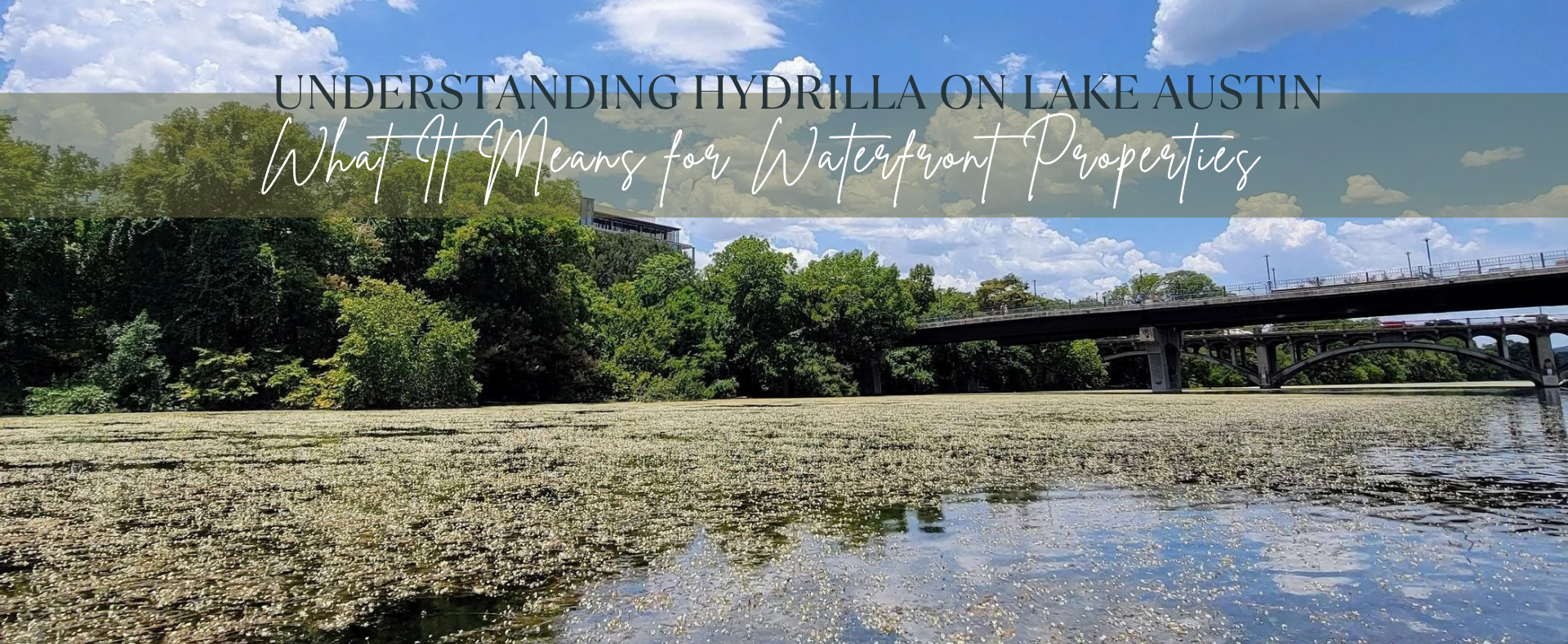
If you've been on Lake Austin recently, you've probably noticed hydrilla making a comeback. For waterfront homeowners and buyers, the big questions aren't just what is hydrilla? They're where is it, how does it affect using the lake, and what can you do about it?
Hydrilla is a fast-growing, invasive aquatic plant, and conditions can vary significantly depending on where you are on Lake Austin.
Where Is Hydrilla on Lake Austin?
According to the City of Austin, a Texas Parks & Wildlife Department vegetation survey in June 2026 identified approximately 575 acres of hydrilla in Lake Austin.
The upper five miles, from Mansfield Dam to the Lake Austin Spa area, remained particularly dense, with hydrilla reported bank to bank in areas. In comparison, the middle portion from Commons Ford Park to Emma Long Metropolitan Park generally had little hydrilla.
That's an important distinction for waterfront buyers: hydrilla is a property-by-property issue.
Two homes on Lake Austin can offer very different experiences depending on the location, cove, water depth, vegetation around the dock and access to open water.
How Does Hydrilla Affect Boating and Lake Life?
When hydrilla gets dense, it can absolutely affect how you enjoy the lake.
No one wants to ski, wake surf, swim or float through thick hydrilla. Dense vegetation can also interfere with boats and propellers and make navigating heavily vegetated shoreline areas more difficult.
There's another problem: hydrilla can spread from fragments. TPWD notes that hydrilla can grow from pieces of the plant, which is why cutting through it with boats or mechanical equipment without properly collecting the vegetation can contribute to its spread.
For buyers who plan to spend a lot of time boating, don't just look at the boat slip.
Look at the entire route from the dock to open water and the areas where you'll actually boat, ski, wake surf and swim.
Can You Remove Hydrilla Around Your Dock?
Hydrilla can be managed around docks, swimming areas and boat-access areas, but it's not necessarily a one-and-done project.
TPWD lists mechanical removal as one method of controlling aquatic vegetation. Cutting, raking and other mechanical methods can provide localized control, but hydrilla may regrow and require removal multiple times during a growing season.
And there's an important rule: the cut vegetation needs to be removed from the water.
Because hydrilla can reproduce from fragments, TPWD warns that leaving cut pieces in the lake can allow the plant to establish in previously unaffected areas.
Aquatic vegetation management in Texas public waters is also regulated. Before removing hydrilla, owners should check current TPWD requirements and make sure any contractor they hire has the appropriate permits or an approved treatment proposal when required.
Is Hydrilla All Bad?
Interestingly, no.
Aquatic vegetation provides valuable fish habitat, and both the City of Austin and TPWD recognize that vegetation can benefit fish and the overall aquatic ecosystem. Hydrilla can provide cover for largemouth bass and other fish, which is why anglers often target areas around vegetation.
The problem comes when invasive hydrilla becomes too dense.
At that point, it can interfere with boating, swimming and recreational access while competing with desirable native vegetation.
That's why the goal isn't necessarily a Lake Austin with zero vegetation. It's finding a balance between healthy aquatic habitat and keeping the lake usable for the people who live and recreate on it.
What Is the City Doing About It?
The City of Austin continues to monitor hydrilla with assistance from TPWD and is using sterile grass carp as one of its primary lake-wide management tools.
In May 2026, the City stocked an additional 2,790 sterile grass carp in Lake Austin, increasing the estimated stocking level from about five to eight fish per acre of hydrilla.
The City has cautioned that homeowners shouldn't expect an immediate reduction. Hydrilla management is a long-term process, and conditions can change throughout the growing season.
What Should Buyers Look For?
If you're considering a Lake Austin waterfront property, don't stop at the view.
Walk the dock and look at the water.
Ask how much hydrilla develops around the dock during peak season, whether the owner regularly clears it, how often maintenance is needed and whether there's a clear route from the boat slip to navigable water.
Water depth, dock configuration, shoreline, vegetation and boat access all contribute to what I call the property's usable waterfront.
Hydrilla doesn't automatically make a Lake Austin property undesirable. But if boating, wake surfing, swimming or fishing is why you're buying waterfront in the first place, you should understand exactly how the water in front of that particular property works before you buy.
Sources
City of Austin – Austin Watershed Protection: Lake Austin vegetation surveys, current hydrilla coverage and grass carp management program.
Texas Parks & Wildlife Department: Nuisance Aquatic Vegetation Program and Hydrilla Management guidance.
Information regarding aquatic vegetation management and permitting can change. Lake Austin property owners should verify current requirements with the City of Austin and Texas Parks & Wildlife Department before removing or treating aquatic vegetation.
Interested in what your home might be worth?
Scan the QR code below for a quick and easy seller evaluation and get an estimate based on current market activity.

Explore more lakefront insights, market guidance, and waterfront buying resources across the Lake LBJ and Lake Travis areas.
📩 Sign up for Lake House Alerts and be the first to know about waterfront and off-market listings around Lake Travis and the Hill Country.

📞Call or text Brooke LeMond at 512-284-0799
Check out this article next